
The Only Important Thing
One rule for life

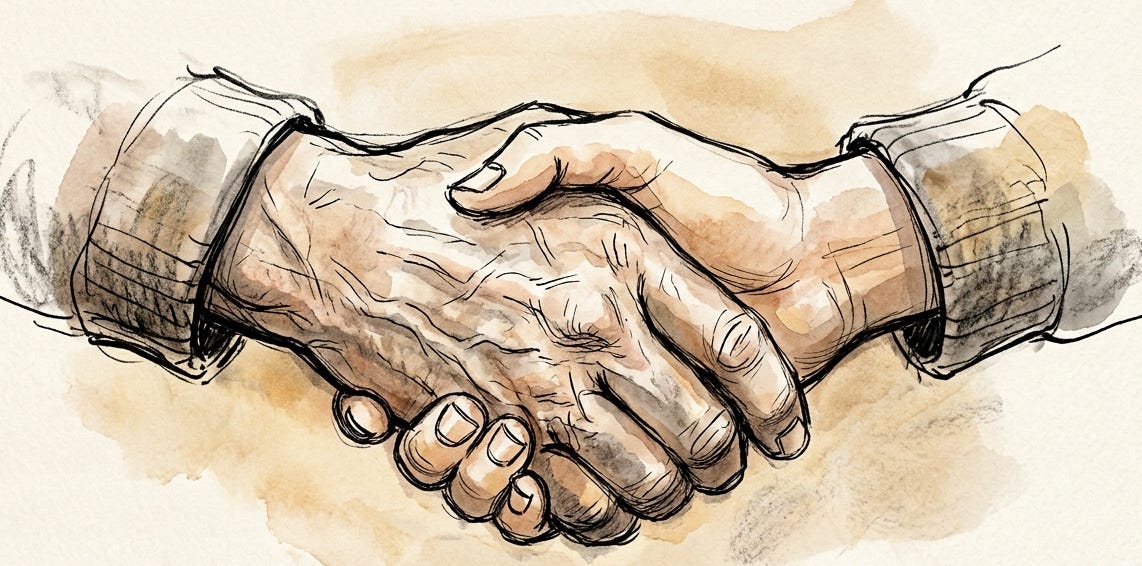
Ok, so the title is a little simplistic. Of course, there is more than one thing of importance in the complex world that we inhabit. My mind is immediately drawn to famine, war, gender violence and global warming. Perhaps that is just me and a natural leaning to a glass-half-empty view.
But I genuinely think that in recent months that is not the case. I think a large part of our belief in what matters is what we are fed daily. On the television, in newspapers, and on our social media feeds. It’s the reason that recently I decided to check out from current affairs and conventional social media. Not indefinitely, but certainly for the foreseeable future.
You might be thinking that I can’t handle the truth. That my fractured, healing ego is too weak to take the events of the day on board. Perhaps. But it occurred to me in this journey that there really was no good news. Everything I was witnessing was misery, and the worst part was that I could do nothing about it, at least not in any meaningful sense.
I’d love to give Putin a good shake and tell him to stop bombing Ukraine. I’d love to get Israel and Palestine together over a coffee. I’d love the climate change deniers to come to their senses. It’s not going to happen though, is it? At least not through my singular action.
Instead, I began focussing on what really matters to me, and to us as humans. Happiness, love, relationships, fulfilment. And this led me on a path of discovery. Principally this was rooted in reading. I read self-help books, philosophy, classic fiction, and contemporary non-fiction. And in this quest, I stumbled upon something that chimed. It was a lightbulb moment.
I had been browsing books on Amazon. And by books, I mean tangible objects. I have nothing against Kindles or their readers at all, but for me the feeling of the paper and the methodical turning of the pages is part of the experience. And as I browsed, I stumbled on a title to which I was probably a little late. Nonetheless, it looked interesting and it arrived the next morning.
The book is called ‘The Courage to Be Disliked’, and according to the cover had already sold over ten million copies. I was late to the party. I was a little dubious of the subtitle that ‘A single book can change your life’, but I parked my scepticism.
Written by Ichiro Kishimi and Fumitake Koga, it is not a conventional read. It charts a relationship between a fictional youth and a philosopher. Their conversations take in all aspects of modern life, and the hurdles we face throughout it. This is broken down in the form of Adlerian psychology, after Alfred Adler, one of the great giants of psychology alongside Freud and Jung. On the surface it might appear complicated but at its heart there is a simple message that is asserted by Adler himself:
“All problems are interpersonal relationship problems”.
When I read this, I re-read it and re-read it again. Could it be that simple?
Of course, this statement simply cannot be entirely true. There are things that are entirely outside of the control of face to face human interaction. Physical illness, natural disasters, road traffic accidents. Even mental illness, though no doubt contributed to by interpersonal relationships, is mostly outside of our control.
And this dichotomy of control is a core principle in Stoic philosophy, that I have written about previously.
But if you were to think of your problems, or conversely even, your happiness, it might not be too farfetched to reduce them to three key domains as Adler did. These three areas are work, friendships and love. I touched on this recently in another article about finding fulfilment and contentment.
All of this is a roundabout way of saying something very simple. You can control only that which is in your control, and that is your interaction with other people and your surroundings.
Now, most of us would profess to being fairly au fait with one of the most basic binaries of life – of right and wrong. For most (but not all) this comes naturally, but also as a result of our conditioning and upbringing. But It is more about how we go about that, in the relationships that we encounter along the way. You can do the right thing but be a terrible, difficult person, just as much as you can do the wrong thing, but on the surface be kind and acceptable. A con artist after all, will steal your money with a smile on their face.
I am guilty of it. I spent many of my formative years of medical training, in hindsight, with a mild arrogance. I thought I knew what I wanted to do. I wanted anatomy and hard science for my surgical career. Why should I learn how to communicate? I had been doing it for 18 years. You can’t teach it can you? It turns out you can actually.
As a junior (now resident) doctor I was, at times, hard on my colleagues. Though I treated every patient well and felt I was doing the right thing, it was the relationships with my fellow workers that would occasionally suffer. In my partial defence, this is sadly a symptom of the system that is suffered by many. I was rude to referrers over the phone and short with members of my own team. At one time I even remember becoming annoyed at how my name badge had been printed, with the hospital switchboard experiencing the sharp end of my opinion.
To my great shame I have at times really upset people. Nobody should go to work expecting to be in tears from the way they have been treated. It only happened once or twice and of course I apologised, but those events will always be a source of regret for me.
Hindsight is wonderful. Though I blamed my behaviour on others, and through my conditioning in the NHS, I have since realised that I could have chosen to be different all along. It was all within my control - I just never realised it.
And I still see it at work. Without fail I see incivility between staff every day, even from the very most senior of my counterparts in the hospital.
If I was to cite the single most important trait for doctors of the future, it would be to have emotional intelligence. That insight into our behaviour, and that of others, forms the foundation of our rapport with our patients and our colleagues. As a profession, we are beginning to realise this now, but we have learnt the hard way over many decades and centuries.
Most complaints in medicine are fundamentally about communication. Most of the problems we have with our colleagues are to do with our relationship with them and how each party reads each other.
So, taking the principles of Adlerian psychology and Stoicism there is only that which we can control. And if all that really matters are our interpersonal relationships (of which we can only impact one side of), then perhaps the most important thing is this:
Treat everyone how you would want yourself or a family member to be treated. You’ll find it’s infectious. Most importantly, it is a conscious choice. It is applicable not just to medical students and doctors, but to everybody.
It is basic humanity.
But that’s not a neat conclusion. At nearly forty I’ve come to a critical realisation, and if I could sum it up in a sentence and into one rule, it would quite simply be this.
“Don’t be a dick.”
It’s better late than never. And if everybody lived by this tenet, we would all be very much better off.
Every medical student and junior doctor should read this post which is full of both wisdom and truth.
You can't control other people, but you can control how you respond to them. It's the ultimate power move.