
Tetris
An allegory for life

Don’t feel guilty if you don’t know what you want to do with your
life…the most interesting people I know didn’t know at 22 what they
wanted to do with their lives, some of the most interesting 40 year
olds I know still don’t.
‘Everybody’s Free (To Wear Sunscreen)’, Baz Lurhmann, 1997, adapted from ‘Advice, like youth, probably just wasted on the young’, Mary Schmich, Chicago Tribune, 1997
It has been some time since my last article. When I first started here, I had no idea what I was looking for or what I needed. But the ability to express in words the thoughts of the last year has proven immensely cathartic. The irony now is that with stability comes a problem - a lack of need and a dearth of ideas. The writing has served its purpose for now.
That does not mean I will not continue to write. On the contrary, there will always be a place for this form of literary therapy, but the content, I suspect, will no longer be so melancholy. It is the end of this chapter. The next is fast approaching, and I am excited as to what that may bring.
“Excited.” Not a word I have heard myself think or say in a while.
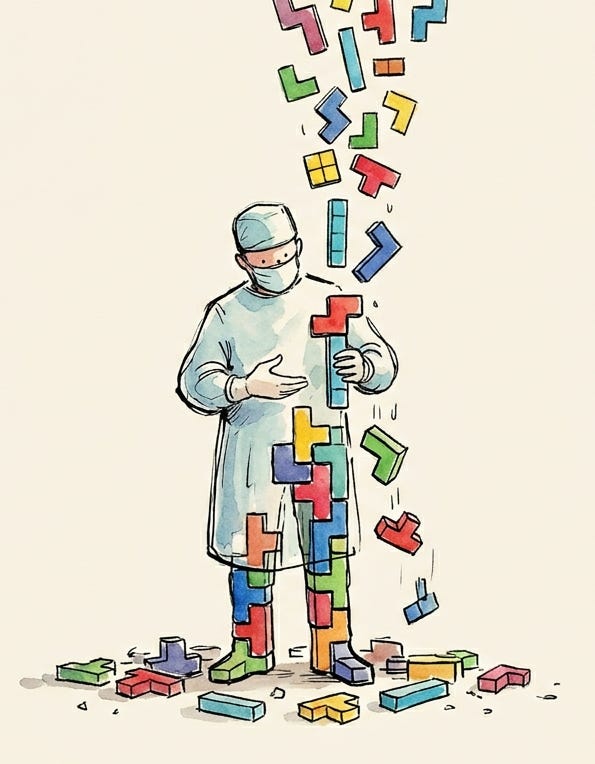
As a youngster I used to play Tetris. Those born this side of the Millennium might not be so familiar with this now vintage arcade game. Blocks of different sizes, shapes, and colours fall down the screen. It is the player’s job to position them and tessellate them with the blocks underneath.
Once a row is complete, it disappears, opening more space above, but if the blocks do not fit, they begin to stack up, and the game becomes harder.
This came to mind today.
It could have been any other morning, slightly overcast and a little warm, but not enough that I didn’t need a jumper. I crossed from the carpark to the hospital not fearful or anxious as before, but with a feeling of lightness. I stopped to look at a heron that had taken up residence on the island in the lake, allowing myself to observe it without a time pressure. I even snapped a picture on my phone for my youngest daughter, who is developing into quite the twitcher.
Entering my office, I turned on the computer and prepped the filter coffee. Soon the familiar, bittersweet smell filled the room, which intensified in my nasal passages as I took a tentative sip.
I greeted my colleagues and presently we had our morning meeting. The whole team seemed in a good mood, and this percolated through the department, much like the water through the ground coffee. Banter and in-jokes flew before we dispersed.
I went to one of the theatres to help with a case. The surgeon who’s list it was, I have known for many years. We trained together in a previous life; a life in which I didn’t quite fit. Square peg, round hole. I could do it, but it wasn’t… me. It suited him though, and I am glad that he has been greatly successful.
In the afternoon I did a couple more cases, interspersed with some emails and admin. At five, I went home and did not look back.
Following that early stint as a surgeon I moved into radiology. I enjoyed the diagnostics, and piecing together the puzzle. Soon however I realised that this wasn’t me either, and in fact I had drifted even further. For some time, I floated aimlessly through postgraduate exams and rotations without really thinking, and without really knowing what I should do.
As part of my training, I did a rotation in interventional radiology (IR). This is a minimally invasive procedural specialty, some parts of which I have alluded to in previous articles. I first had experience of this in general surgery. Instead of me taking a ruptured spleen to theatre for major surgery and removal of said organ, the radiologist on call stopped the bleeding with a couple of small metal coils delivered through a catheter in the splenic artery. The procedure took no more than twenty minutes, the patient survived, kept their spleen, and went home the next day with a small plaster on their groin.
It was like magic.
The diversity of this specialty is huge: Blocking off internal bleeding, fixing aneurysms through just a pin hole in the groin, draining life-threatening infection, or removing clots from arteries in the brain. The list could go on. Ultimately though, I could use my hands and remain a generalist, and this appealed to me.
And now, that’s what I do. I specialise predominantly in blood vessels. Arteries and veins – blocking, opening, repairing. All through a cut no bigger than a couple of millimetres in the wrist or groin. It is just plumbing, but with higher stakes. To me though it makes sense.
But why is this relevant?
Well, this sort of journey applies to many, in any walk of life. We don’t often know what we want at the start. In fact, very few of my colleagues ended up doing what they intended to on the first day of medical school. And although it is natural to meander, I think we can all sometimes be guilty of putting unnecessary pressure on ourselves. It’s the pressure to find a fit and to continue to strive for the next thing. But in continually striving we lose sight of something fundemental – fulfilment.
As I left today I called my wife to say I was on my way and I heard my children in the background. As I walked the return journey past the lake I stopped to gaze at a duckling. It can’t have been more than a week old. A sign perhaps?
The traffic wasn’t great, but that didn’t matter. I put some old music on and opened the windows. I felt odd, but in a good way, and I couldn’t quite put my finger on it.
My conclusion is that we are all just Tetris blocks floating through this life and finding our fit. When we do, the line disappears, space opens, and life becomes that little bit easier. If the fit is not right, we can find it increasingly challenging.
I realised today that I have found my fit. A balance of family, leisure, and work, in that order. I am fulfilled, and critically my identity is not defined by my profession now.
And that unrecognisable feeling that evaded me?
That feeling is contentment. I know now that it’s the only thing truly worth striving for.
I really love your writing – there is always such a genuine and honest feel to it.
The Tetris metaphor is a clever way to show what it felt like to finally find your groove after years of trying to force things that just didn't fit, and it captures that satisfying click of pieces finally aligning.
It’s incredibly refreshing to hear a doctor talk so openly about finding identity outside of the hospital, and that transition from the intensity of IR to just enjoying a quiet moment by the lake- again just feels very real.
There is something very comforting about the personal and grounded manner you write.
A six month sabbatical did wonders for finding the person behind the father, husband, and surgeon.