

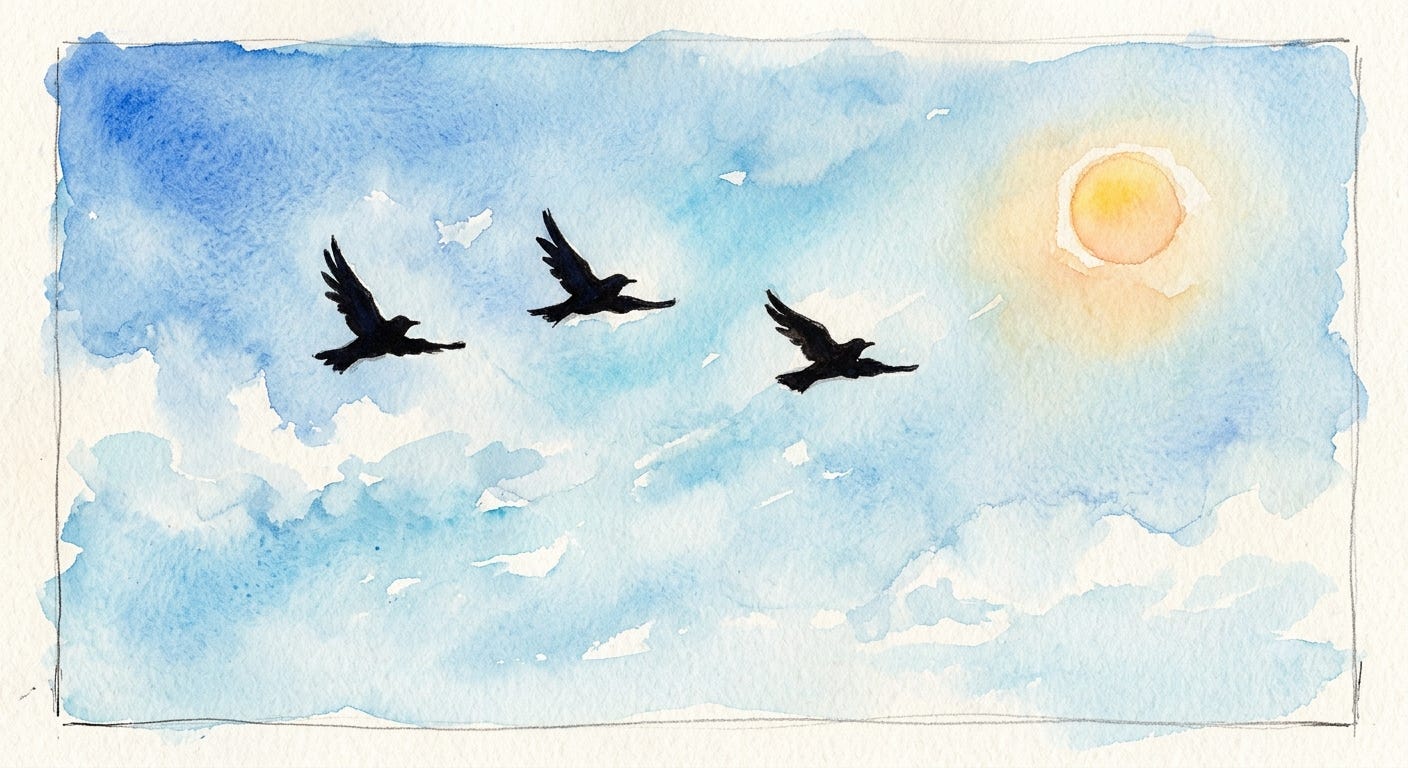
It’s six O’clock on a Saturday morning. It has been a busy week, and usually I wouldn’t be up at this hour on a weekend. But this is the new normal, at least for now, and it’s because of the heat - going to sleep and staying asleep have become somewhat challenging. Looking at the forecast on my phone, it is already twenty one degrees and the sun is barely up. The trace of dew that I initially felt on my feet as I crossed the garden has already dried up, leaving the soil parched, and the grass ever-more bleached.
There is a black coffee beside me that I’m allowing to cool, which is taking longer than usual. I’m practising being present and trying to appreciate the surroundings and not look at my phone. I love the garden in this weather. It’s not big but it’s our little island of peace and seclusion in town. Grasses sway languidly near where I am sitting and the odd waft of Salvia floats over me on the gentlest of sea breezes. I admire the trees that were planted last year – I worried it was too dry at the time. I needn’t have. They’ve flourished along with the rest of the garden.
I really have come to appreciate the trees, flowers and shrubs that my wife has carefully chosen and cared for. A few years ago, I wouldn’t have even noticed. Learning all about them, including their Latin names, has been an education.
But I’ve noticed something else too on these early mornings. Sitting in the quiet of the early hours, before the bustle of the surrounding streets begins, the chorus of birdsong around me is evident. And I’ve taken this interest one step further – I have downloaded an app. I won’t publicise the name, but it recognises the calls of birds and identifies them on the screen (I will allow the phone for this!). As with most technology I was sceptical at first, but to my amazement, it really does work. Now, sitting and listening in to the cacophony of noises around me has become part of this summer’s routine.
I recently finished a fascinating book.
A World Appears by the well-known author Michael Pollan, had been on my reading list for a while. In it Pollan explores what it means to be conscious. How is it that the workings of our brain, the neural pathways, chemicals, and synapses, are also accompanied by feeling, thought and a sense of what it is to be us?
I suspect I will have to read it again to fully grasp some of the concepts, but I was no less fascinated by what he presents using theories rooted in science, philosophy, and spirituality. Of course, there were several nods through the course of the book to artificial intelligence. The big question proposed is whether consciousness could ever be engineered into a computer. I am no expert on AI, but I have an opinion, which is this:
To be conscious it must feel like something to be ourselves. Sitting here, I can feel the sun’s warmth on my skin, I can smell flowers on the breeze, and I can hear birdsong. I do find the concept that a computer could appreciate all these things a difficult one. A computer may be able to sense them objectively, but appreciating them for what they are is a different matter altogether.
But the main point is in the title of the book. My app has counted thirteen different bird species in only an hour. The usual suspects are there of course – Pigeon, Magpie and Gulls. But there are others. Dunnock, Great Tit, Coal Tit, Sparrow, Robin and even a Jay. I catch the blue flash of its wing in a nearby treetop.
Thirteen different species in an hour - A new world has appeared above me. It was always there though. I just never properly looked.
And it’s got me thinking. If there is a world up there that I have taken for granted for nearly forty years, then what other worlds are there that I have not seen? What about the worlds that aren’t filled with wonder and beauty?
Before I started in medicine, I was naïve and certainly had lived a sheltered existence. As a privately educated boy from the South, working in certain areas in the country opened my eyes to deprivation and all the consequences that it brings. Poor health, drugs, alcohol, child poverty and neglect.
And there are other worlds too. They are right in front of our eyes.
The high street vape shops serving as fronts for organised crime, nail bars where modern day slavery operates in plain sight. Homelessness and sex work, all of which is happening much closer to home than we might think. Only recently an elderly patient divulged decades of physical and psychological domestic abuse to the team during a procedure. They had not told anyone before, and all it took was the kind inquisitiveness of a nurse, to uncover it. That patient had neighbours and acquaintances. They had not seen it.
Increasingly, as a society we are becoming less present. Screens and headphones have numbed us to our surroundings and to our fellow man and woman. We don’t talk to each other anymore.
But if each of us was more present, and if we scratched at the surface only a little it would be amazing what world we may uncover next. It might be beautiful. It might be darker. But perhaps that awareness is all we need to function a little more compassionately as a society.
I would be interested to know what world appears to you next.
Fabulous. Love it. I would never have imagined when I was training as a surgeon that there were others out there thinking this kind of thought. It’s a whole new camaraderie and I’m so grateful for it. Thanks for this lovely piece.
Another excellent piece!
I'm far from an expert, but I am very much convinced that the whole presence project as so much better framed in terms of curiosity, both about the mind and the world. Chasing relaxation feels doomed to failure, but curiosity seems to get one there sideways.
P.S. I really really really want to know the name of the bird app so I can download it.