
Black Wednesday

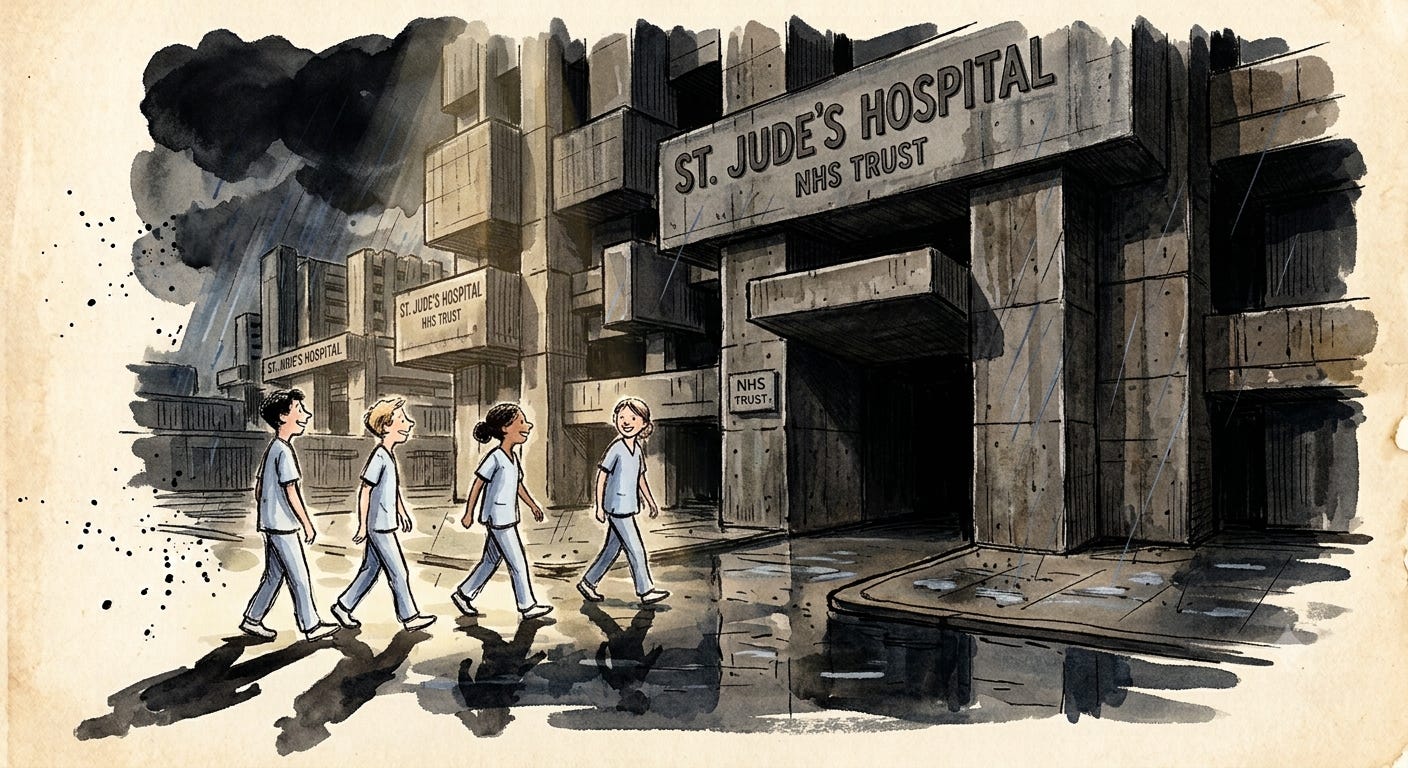
It’s that time of year again.
Next week, on the first Wednesday in August, a new intake of fresh-faced resident doctors steps onto the wards of hospitals up and down the country. Years of training has culminated in this moment. It is a day filled with apprehension and hope, in equal parts. I remember my first day as a fully-fledged doctor like it was only yesterday. But that was now fifteen years ago.
Passing final medical school exams marks the end of the first chapter, but there is really nothing much ‘final’ about it. It is not long before the giddy relief of passing, accompanied a month later by the first pay cheque, fast transforms into a realisation that medical school was just the prologue – the easy part. The slog then continues in earnest alongside a dwindling sense of importance, and an increasing sense of anonymity.
I like this time of year. I enjoy seeing the fresh faces of new doctors, innocent and unencumbered by the rigours of the job. They still exude that sense of vocation before becoming prisoners to the rota.
And the name we give to this day of hope? Black Wednesday.
There is a perception amongst all of healthcare that on this day, when new doctors start, and others move into their next rotations, that there is an upstroke in patient mortality. Digging into the data, there is actually very little good evidence for this. Even so, I have known, and still know, a few consultants who actively seek to take this week as annual leave.
It is too basic a conclusion however, to pin the fault of any excess mortality on a single group. Whether or not there is a true effect would be as a result of a number of other factors. New rotas, unfamiliar environments, knowledge gaps, and a breakup of teams formed over the last four to 6 months. These are systems issues.
So, imagine being filled with all that hope, only to be welcomed with this phrase, the implication being that you are so useless, you are a risk to your patients. When framed like this, the dark humour that often accompanies this week all but leaves.
Not only does it do nothing for self-esteem on an individual level, but it also sets a precedent that creeps through other healthcare professional groups. It perpetuates the belief that these bright young things are actually all a bit useless, and with that sentiment comes rudeness and lack of respect. It is not just doctor on doctor. I see it from nursing staff, therapies teams, and administrators.
The hierarchy and infantilisation are set from day one.
I was useless on my first day, truthfully.
My first shift was an evening in Accident and Emergency. Scrubs on, stethoscope around the neck, I stepped, terrified, onto the ‘shop floor’. I even remember the first patient. Elderly, frail, and septic from a urinary tract infection. What should have been a half an hour check in took far longer. Two hours later I was just about ready to hand the patient over to the acute medical team. It would have been longer had I not needed help with almost everything. I couldn’t get a cannula in. I couldn’t place a urinary catheter. I didn’t know how to get an X-ray or an ECG. I had no code for the blood gas machine.
And with hindsight, in this single-patient example, it is easy to see how harm could have been done. We know now that patients like this do incrementally worse the longer they wait for appropriate treatment.
I handed the patient over to the admitting team, feeling the eyes of my registrar and consultant burning into the back of my neck, and picked up the next patient’s file.
That I remember this case so acutely says a lot. Though I received help, I remember it being provided begrudgingly. There were no niceties, particularly in a demanding environment like A&E. It didn’t get easier in that first job either, as I started night shifts, with very little back up from my seniors, who were themselves working flat out in other parts of the hospital.
But throughout the year I began to learn, I became slicker and more effective. A year passed, and I forgot my first days. I joined in with the rest of the hospital, forming my own part of that unwelcoming environment, elevated by a little bit more self-importance, that then started compounding like interest, year on year.
Until one day last year I was truly humbled. It only took one case to put me right back to the beginning. Those feelings of inadequacy and unease, verging on paranoia, came back. Three years as a consultant, and it may as well have been my first day of medical school. Medicine can be cruel like that. Though in that cruelness, there is a hidden kindness. A kindness that has highlighted your fallibility and your vulnerability.
It is the silver lining of a complication.
I will never be the same after last year. I will be better. I am better.
Any ego I had before was shattered, and I have rebuilt it sympathetically. When I see these young doctors starting their journeys, I feel hope vicariously.
The term ‘Black Wednesday’ should be resigned to the archives. Not simply because of the weak evidence base, but because of the effect it has on the system. If we don’t change our attitudes, we will only perpetuate these negatives.
I’d like to think a few new resident doctors might be reading. I’d like to say this:
We have all been there and we are still here. Try your best, ask questions and show initiative. Above all be kind to each other, your patients, and the teams around you and you won’t go far wrong. The system will only change if we do.
I don't remember the details 21+ years later, but I remember the terror. Thank you for this and I thought given such sound advice. Thank you for mentioning the humbling moments later on evoke those feelings.
Thanks for this post!
100%
I remember my first day (year 2000) like it was yesterday. Agree - be kind, ask questions, speak up the rest will follow.